In the Humble Opinion of LittleBill, Socialist, Atheist, and Humanist
English as a 2nd Language for Republicans - 101B

You don't modify a noun with another noun.

In his state of the union speech, how many people watching noticed that Bush referred to the results of last November's election as producing 'a new "Democrat majority" in Congress?

I did. I notice it every time a semi-literate Republican uses that term. Bush never apologized, of course. (He never apologizes, does he?)All he said on NPR Monday was,

That was an oversight. I'm not trying to needle…. I didn't even know I did it. . . I didn't mean to be putting fingernails on the board. I meant to be saying, Why don't we show the American people we can actually work together? Gosh, it's probably Texas. Who knows what it is? But I'm not that good at pronouncing words anyway.
In his case, some may grant his honesty, because he is the worst-spoken American president. But Maura Reynolds, writing in today's Los Angeles Times is not willing to cut him that slack. She says it's a deliberate slurring of the Democratic Party to refer to it as the 'Democrat Party'. Reynolds quotes Daniel Weiss, chief of staff to Rep. George Miller (D-Martinez):
It's a long-standing intentional partisan political slight. It's kind of like flashing colors in a gang. It's code. It says, 'I'm one of you, I'm a right-wing conservative.'
The issue of whether it is a slur to refer to the Democratic Party without the "-ic" has become an irritant. It comes at a time when Democrats and Republicans are trying to figure out whether they can work together, after years of fierce partisanship in the nation's capital.
Roderick P. Hart, a professor of communications and government at the University of Texas in Austin explains:
The word 'democratic' has such positive emotional valence … so they politicize it to use it as a term to describe a group of political rivals.
Hart says that "Democrat Party" is not common usage in Texas and notes that the only people who use it were "sitting Republican legislators."

But Reynolds has done her research:
The use of the term "Democrat Party" goes back decades. One explanation sometimes offered is that Republicans began to use it to hint that corrupt Democrats were not terribly "democratic" and had no right to use that word to describe themselves. Others say it was adopted because it sounds annoying and echoes the word "bureaucrat," with its negative connotations.

Whatever the initial impulse or rationale, the term became controversial as far back as the 1950s. Sen. Joseph McCarthy (R-Wis.) famously used it to deride Democrats during his hearings investigating whether Communists had infiltrated the U.S. government. During the 1956 Republican convention, the usage was so common that it prompted the New York Times to report that dropping the "-ic" had become official party policy.

"'Democratic' as an adjective is not descriptive of the party as it exists today," GOP spokesman L. Richard Guylay explained in that report, referring to allegations of vote-fixing by the Democratic Party's political machine in large cities. "I can't consider the party of the Pendergasts or Tammany Hall as a democratic party."

In 1957, writing about the phenomenon in American Speech, the quarterly journal of the American Dialect Society, scholar Ignace Feuerlicht wrote: "It will be interesting to see whether 'Democrat Party' will stay with us or go out of existence again or be revived and revitalized at intervals just before successive national elections."

Feuerlicht seems to have been prescient: A search of a database of presidential speeches and remarks shows that use of the term has increased during election seasons and has been aimed primarily at partisan audiences.

President Reagan used it more in 1984, the year of his reelection campaign, than at any other time in his presidency. In the case of President Bush, the term shows up in his remarks more in 2004 and 2006 — both election years — than during the rest of his time in office.

In fact, Bush's usage of the term increased dramatically last year; according to the American Presidency Project, based at UC Santa Barbara, the president was recorded using the term 22 times in 2006 — more than in the previous five years of his presidency combined.

The term also is commonly used by other Republican leaders. On Monday afternoon, the office of the top GOP leader in the House, Minority Leader John A. Boehner of Ohio, issued a news release asking, "What is the Democrat strategy in Iraq?"

Some Democrats doubt that the president is truly unaware of the pejorative tone of the term, but others acknowledged that it might have become such common parlance among Republican politicians that Bush used it without understanding its origin or undertones.
Reynolds gives Roderick Hart the last word:
It sounds illiterate to me. It's a noun used to modify a noun, and everyone knows you use an adjective to modify a noun.
There you have it, Folks: the reason why English isn't the official language of the American people is that almost half of our political 'leaders' haven't mastered it yet.

Herein endeth Lesson #2!

English as a 2nd Language for Republicans - 101A

Unless you are in uniform, George Bush is not your Commander-in-Chief.

Excerpts from Garry Wills, At Ease - Mr. President, New York Times. Wills is professor emeritus of history at Northwestern. He says the expression of commander-in-chief is one of the most abused terms in our political lexicon:

. . . . The president is not the commander in chief of civilians. He is not even commander in chief of National Guard troops unless and until they are federalized. The Constitution is clear on this: “The president shall be commander in chief of the Army and Navy of the United States, and of the militia of the several states, when called into the actual service of the United States.”

When Abraham Lincoln took actions based on military considerations, he gave himself the proper title, “commander in chief of the Army and Navy of the United States.” That title is rarely — more like never — heard today. It is just “commander in chief,” or even “commander in chief of the United States.” This reflects the increasing militarization of our politics. The citizenry at large is now thought of as under military discipline. In wartime, it is true, people submit to the national leadership more than in peacetime. The executive branch takes actions in secret, unaccountable to the electorate, to hide its moves from the enemy and protect national secrets. Constitutional shortcuts are taken “for the duration.” But those impositions are removed when normal life returns.

But we have not seen normal life in 66 years. The wartime discipline imposed in 1941 has never been lifted, and “the duration” has become the norm. World War II melded into the cold war, with greater secrecy than ever — more classified information, tougher security clearances. And now the cold war has modulated into the war on terrorism.

There has never been an executive branch more fetishistic about secrecy than the Bush-Cheney one. The secrecy has been used to throw a veil over detentions, “renditions,” suspension of the Geneva Conventions and of habeas corpus, torture and warrantless wiretaps. We hear again the refrain so common in the other wars — If you knew what we know, you would see how justified all our actions are.

But we can never know what they know. We do not have sufficient clearance.

When Admiral William Crowe, the former chairman of the Joint Chiefs of Staff, criticized the gulf war under the first President Bush, Secretary of State James Baker said that the admiral was not qualified to speak on the matter since he no longer had the clearance to read classified reports. If he is not qualified, then no ordinary citizen is. We must simply trust our lords and obey the commander in chief.

The glorification of the president as a war leader is registered in numerous and substantial executive aggrandizements; but it is symbolized in other ways that, while small in themselves, dispose the citizenry to accept those aggrandizements. We are reminded, for instance, of the expanded commander in chief status every time a modern president gets off the White House helicopter and returns the salute of marines.

That is an innovation that was begun by Ronald Reagan. Dwight Eisenhower, a real general, knew that the salute is for the uniform, and as president he was not wearing one. An exchange of salutes was out of order. (George Bush came as close as he could to wearing a uniform while president when he landed on the telegenic aircraft carrier in an Air Force flight jacket).

We used to take pride in civilian leadership of the military under the Constitution, a principle that George Washington embraced when he avoided military symbols at Mount Vernon. We are not led — or were not in the past — by caudillos.

Senator Daniel Patrick Moynihan’s prescient last book, “Secrecy,” traced the ever-faster-growing secrecy of our government and said that it strikes at the very essence of democracy — accountability of representatives to the people. How can the people hold their representatives to account if they are denied knowledge of what they are doing? Wartime and war analogies are embraced because these justify the secrecy. The representative is accountable to citizens. Soldiers are accountable to their officer. The dynamics are different, and to blend them is to undermine the basic principles of our Constitution.
This is Lesson #1.

Interview with a Taliban Commander

Excerpts from Claudio Franco's Taliban explain how and why they fight:

The unit's commander, who gave his name as Musa Khan, was a short, lean 40-something man sporting the mustache-less beard of hard-line militants.

Musa Khan said his unit had 25 to 30 fighters, a handful of whom were deployed on the hilltops surrounding the interim base, securing all the potential access routes to the camp. This is how the Taliban operate in the eastern provinces, Musa Khan explained through a translator that they are organized in

groups of 20 to 40 lightly equipped men who are extremely mobile and effective in this rugged terrain.
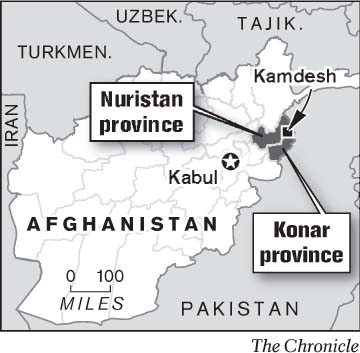
They can move across their zone of operations -- from Karongal to Shaygal in the north, Chowki to the south, Nuristan to the west and the mountainous Kamdesh area along the Pakistan-Afghan border to the east, in essence almost anywhere in the 3,000-square-mile region -- in a matter of hours, invisible to anything but helicopters. "And those can't fly too low," he said, pointing at the rocket-propelled grenade launcher by his side.

Over the years, Musa Khan has learned to trust the stringent logic of hit-and-hide tactics:
The U.S. helicopters cannot land if we are around, and they can't always target us from the air. They know we only need a split second to hit them and disappear. We only assemble with other units for large-scale attacks. With a few hours' advance notice, we can be virtually anywhere in the province. Once we have split up, it's extremely difficult to locate us without risking being hit.

The movement's leadership is growing in confidence, the commander said, and the same applies to the rank and file:
There are five young men ready to enlist for every fighter killed by coalition forces, and this is something you can't buy with money.
Enlistees also get paid approximately $140 per month by the Taliban, compared to $100 paid by the Afghan National Army.
Afghanistan has grown used to being the victim of others' foreign policy interests. NATO's expansion to the east is a sign that the U.S. is tired. Bush's strategists think that fighting under NATO command will shield the U.S. from the backlash resulting from their eventual defeat in Afghanistan.
Away from their commander, the mujahedeen were remarkably talkative. Hamid, whose black, Kandahar-style turban stood out among the ubiquitous pakol, the traditional felt berets of the Afghan east, knew about "a constant flow of arrivals from Pakistan" -- they were Arabs, he said, but he didn't know precisely where they came from.
Some of them stay for six months and then go back, nobody knows where. They pay a lot to get in and out. None of them will talk, but they come here to train, I guess. Al Qaeda has its own network in Konar and Nuristan (provinces); they don't need us.
Hamid said the Afghans and the Arabs have a common enemy, but don't necessarily like each other. He described the Arabs as firebrand Islamists who don't obey orders and are obsessed with martyrdom.
They won't stop shooting even when they are told to. And they always write messages home before a battle -- they get ready to die. I know them well, and I don't like them; they just don't trust Afghans.
The fighters are confident about the conflict's outcome.
The American troops move slowly, they carry pounds of body armor and equipment. You can't win if you can't move on these mountains. Their helicopters are the only real danger for us, but we have learned how to hit them, even without Stingers.

You must understand, that one Arab is worth 10 Afghans in terms of religious zeal. They truly hate the West and all Westerners, without exception. They would never allow the press on these mountains. They are not fighting our war, but their own personal jihad. Protecting their own people and achieving martyrdom are their first priority.
Musa Khan said he is convinced that growing numbers of Afghans would prefer a return of the Taliban and strict Islamic rule:
Our people have learned the truth about (Afghan President Hamid) Karzai and his democracy. The Taliban are an alternative to corruption and incompetence. We aim to be a political movement, but won't disarm until the last infidel is gone. Afghans don't need democracy, but the return of the Islamic Emirate.

It's just a matter of how many corpses the American public will need before realizing that 'Enduring Freedom' was definitely a bad idea. It took 10 years for the Russians, and you are already halfway through. Do you really want to be as stupid as the Russians?

Jugnu Mohsin

Colleagues, I have to share with you another sterling feature of BBC, "The Interview". As I have said before, no one (in the world) does Interview better than the 'Beebe'. This morning's subject was Jugnu Mohsin. BBC describes her as

one of Pakistan’s leading journalists. She is the co owner of and columnist for Pakistan’s leading satirical magazine the Friday Times. Based in the country’s cultural capital Lahore she is a very well known figure in the small elite that dominate Pakistani politics and social scene. In fact many leading Pakistanis read her articles with a slight sense of foreboding – wondering whether this week Jugnoo has them in her sights.
Friday Times editor Najam Sethi and publisher Jugnu Mohnsin, (husband & wife), were winners of a 1999 Press Freedom Award.

If you have a block of time, you should give it a listen. Because I woke up this morning in the middle of it, I initially mistook her as an American discussing my country. You can listen to it while you take time to clean up your desk.

State of the Nation

Well, at least this time he didn't do the Bush Bounce or smirk or wink. He almost looked presidential. However, he did manage to fool some of the people again into a small rise in support for his war.
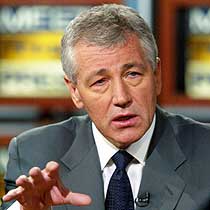
As usual, Bush invited carefully selected guests of honor to make himself look good to the groups they represent. The young woman entrepreneur is to be admired and commended. And the two men are outstanding genuine heroes. The unfortunate thing is that he used them as examples of how noble, generous, and courageous the American people are. All this hyperbole despite the fact that a very small percentage of Americans have been willing to give their lives for their nation or Bush's cause. For example, I do not know a single soul who is presently serving in the armed forces, and I doubt that very many of us do.

Another angle Bush used was at the end of his speech, when he said words to the effect that many of us may not have voted for the war, but we did not vote for failure. There is a moral point here that still bothers me. He led this country into a war of his choosing through lies and deception. Because of that, he does not deserve victory, nor unfortunately, do the people of this nation who either followed him or were dragged inadvertently into it. He should apologize to the world and our citizens, declare defeat for himself, and withdraw. We should consider our nation lucky if we can work out some agreement under which NO sides are losers. Like them or not, we are not the only perfect humans in the world, and other nations and beliefs have to be considered.

Surging Deeper?

San Francisco author Adam Hochschild's books include Bury the Chains: Prophets and Rebels in the Fight to Free an Empire's Slaves. He is writing a book on World War I. This piece also appears in the San Francisco Chronicle.

Digging a deeper hole
Like World War I, Iraq surge is move doomed to fail


If we needed more evidence that those surrounding President George W. Bush have a tin ear for the lessons of history, it came recently when National Security Adviser Stephen Hadley referred to increasing the number of American troops in Iraq as "the big push" that would bring victory closer.

"The big push" is a phrase that came into the language with another troop surge that was supposed to bring another war to victory. For months beforehand, the big push was how British cabinet ministers, propagandists, generals and foot soldiers talked about the 1916 Battle of the Somme. (It is even the title of a book on the subject.)

World War I had been in a deadly stalemate for the better part of two years. A string of horrific battles had revealed the huge toll of trench warfare: Defenders could partially protect themselves by building deeper trenches, concrete pillboxes and reinforced dugouts far underground. But when you attacked you were disastrously vulnerable -- out in the open, exposed to deadly, sweeping machine gun fire as you clambered slowly across barbed wire and water-filled artillery shell craters.

So, what did the Allies do? They attacked. In numbers of men involved, it was at the time history's largest battle. The plan was to break open the German defense line, send the cavalry gloriously charging through the gap, and turn the tide of the war. The result was a catastrophe. The British army lost nearly 20,000 soldiers while about 40,000 more were wounded or went missing -- all on the first day. German machine gunners, after waiting out the long preliminary bombardment in their fortified bunkers underground, returned to the surface in time to mow down the advancing soldiers. After 4 1/2 months of fighting, British and French troops had suffered more than 600,000 casualties and the big push had gained them roughly 5 miles of muddy, shell-pocked wasteland.

Like the big push of the Somme, the big push in Iraq is a reapplication of tactics that have already proven a calamitous failure. As the outspoken retired U.S. Army Lt. Gen. William Odom, former director of the National Security Agency, puts it, it's like finding yourself in a hole and then digging deeper. Every piece of evidence from nearly four bloody years makes clear that Sunnis and Shiites alike are driven to rage by the very presence of American soldiers walking Iraqi streets, barging into Iraqi homes and arresting or killing people who may or may not be insurgents. Furthermore, the people arrested or killed, however unsavory, are sometimes the only force protecting their communities against attacks from the opposite side in an extremely bitter civil war. Therefore, as sociologist Michael Schwartz explained the matter recently, a previous joint U.S.-Iraqi counterinsurgency drive in Baghdad, of exactly the type now being planned, actually increased civilian casualties.

There are huge differences, of course, between World War I and the fighting in Iraq. But even beyond the optimistic talk of the big push, there is nonetheless another eerie resemblance between the two conflicts. In both cases, a great power was itching to launch an invasion, and seized on a handy excuse to do so. For the Bush administration, of course, the excuse was Sept. 11. From a long string of insider revelations, we know that its top officials were hungry to invade Iraq, looked eagerly for the most far-fetched connections between Saddam Hussein and Sept. 11, and, even when not really finding them, invaded anyway -- while continuing to vaguely imply the connections were there.

Something remarkably similar happened in 1914. Austria-Hungary was a shaky empire of restless ethnic minorities ruled by a German-speaking elite in Vienna. Nearly half the population was Slavic, including many Serbs. As a result, the imperial rulers in Vienna felt threatened by the very existence on their border of the independent nation of Serbia, small though it was. They were determined to invade it, possibly partition it, and so stamp out pan-Slavic and Serbian nationalism once and for all. They drew up detailed invasion plans. Then, most conveniently, Archduke Franz Ferdinand of Austria-Hungary, the emperor's nephew and the heir to the throne, was assassinated while on a visit to the provincial city of Sarajevo. Like the White House after Sept. 11, the imperial palace in Vienna promptly began an eager search for a connection to the Serbian government. Frustratingly, however, the archduke had been killed on Austro-Hungarian soil by Gavrilo Princip, an Austro-Hungarian citizen. The assassin, an ethnic Serb, indeed had help from a shadowy secret organization of Serbian nationalists, but no connection to the government of Serbia has ever been proved. No matter. Austria-Hungary declared war on Serbia anyway. Other countries quickly jumped in on both sides, and a conflagration began that remade the world.

Part of that remaking, ironically, was the cobbling together after the war of three provinces of the defeated Ottoman Empire into what was first a British protectorate and then, after 1932, independent Iraq.

There is a final resemblance between the present bloodshed there and World War I. Both conflicts were fought for a curiously shifting set of noble-sounding goals. With Iraq, the Bush administration has tried on for size finding weapons of mass destruction, combatting Islamist terrorism and installing democracy in the Arab world. In World War I, the Allies first talked of coming to the defense of innocent, invaded little Belgium, then of defeating German militarism and of defending the British and French way of life.

Once Woodrow Wilson brought the United States into the conflict, he spoke of "the war to end all wars." It didn't. The humiliation of the losers and the catastrophic loss of life on both sides did nothing to end all wars and much to light the fuses of later ones -- especially the Russian civil war and World War II.

The longer the war in Iraq goes on and the more American troops are planted by big pushes in a highly combustible part of the world, the more we will continue to stoke a widespread humiliation and anger whose consequences are already guaranteed to haunt us for decades to come.

The One-Sided Religious War

Although the current war has been labeled as the War for Freedom, that title is really misleading, as well as being extremely nebulous. The war, we are told, is a war to prevent the Islamic world from taking over our so-called democracy. In actuality, the war is a religious war on both sides. We have a president who has unwavering religious beliefs, and he has made very good use of the Christian right as his base from which to garner support. In spite of the fact that his speeches are heavily laced with mention of God and Christ, he has avoided using those words as motivation – only freedom.

Religious belief varies to a great degree in this country, from sect to sect, and from one individual to another. The same is probably true around the world, although there are countries in which it is not wise to let individual belief be known. Try to envision, therefore, how you as an individual would react if another nation, especially a nation with a religious motive were to invade.

Would you rise up as an individual to protect your country? Many Americans are heavily armed, but mostly with fairly unmilitary arms, and mostly to kill other Americans for one reason or another. But would that stop you from coming to the defense of your country? If you were a devout Christian, would you be willing to give your life for Christ? If you were an atheist, but also an American, would that make you any less likely to die for your country? And just what labels do you think the oncoming hordes would use to describe us? Terrorists? Insurgents? Extremists? Do you think they would know whether each and every one of us was an evil adversary? Do you think they might believe that some of us could simply be trying to protect our families, our homeland, and our way of life with whatever we had at hand?

Do you suppose that there are any people like those I’ve just described in Iraq or Afghanistan?

Meet Chuck Hagel

By Robert Scheer

Chuck Hagel for president! If it ever narrows down to a choice between him and some Democratic hack who hasn't the guts to fundamentally challenge the president on Iraq, then the conservative Republican from Nebraska will have my vote.

Yes, the war is that important, and the fact that Sen. Hillary Clinton of New York, the leading Democratic candidate, still can't or won't take a clear stand on the occupation is insulting to the vast majority of voters who have.

Sen. Hagel is a decorated Vietnam War vet who learned the crucial lessons of that Democrat-launched debacle of post-colonial imperialism. Even more important, he has the courage to challenge a president from his own party who so clearly didn't. Hagel said,

The speech given by this president represents the most dangerous foreign policy blunder in this country since Vietnam. We are projecting ourselves further and deeper into a situation that we cannot win militarily.

To ask our young men and women to sacrifice their lives to be put in the middle of a civil war is wrong. It's, first of all, in my opinion, morally wrong. It's tactically, strategically, militarily wrong.
If Sen. Barack Obama of Illinois, another Democratic darling, has uttered words of such clarifying dissent on the president's disastrous course, then I haven't heard them. Instead, too many leading Democratic politicians continue to act as if they fear that if they are forthright in opposing the war, they will appear weak, whether on national security or the protection of Israel, and so ignore the clear, strong voice of the American people that just revived their party's fortunes.

Ever since President Ronald Reagan painted foreign policy as a simplistic war of good versus evil, the Republican Party has been in the thrall of neocon adventurers. Yet, the national emergence of Hagel reminds us that, two decades earlier, it was Dwight D. Eisenhower, a war hero and a Republican, who was the only president to clearly challenge the simplistic and jingoistic militarism that most Democrats embraced during the Cold War. It was Eisenhower, in fact, who refused to send troops to Vietnam, and his Democratic successors who opened the gates of war.

True conservatives, going back to George Washington, have always been wary of the "foreign entanglements" that our first general and president warned against in his farewell address. And it is in that spirit, recognizing the limits to U.S. military power, that Hagel spoke this past Sunday on NBC's "Meet the Press."

Independent Sen. Joseph Lieberman of Connecticut, late of an oft-opportunistic Democratic Party that saw fit to nominate him as recently as 2000 for the vice presidency, had just finished accusing those who don't support President Bush's escalation of the war of being "all about failing." In his defense of the indefensible, Lieberman baldly repeated many of Bush's lies that launched this war four years ago. Said the fear-monger,
The American people ... have been attacked on 9/11 by the same enemy that we're fighting in Iraq today, supported by a rising Islamist radical super-powered government in Iran. Allowing Iraq to collapse would be a disaster for the Iraqis, for the Middle East, for us, that would embolden the Iranians and al-Qaida, who are our enemies. And they would follow us back here.
Never mind the ridiculous image of "super-powered" Iran invading the United States, or the fact that foreign jihadists -- arriving after the overthrow of anti-fundamentalist strongman Saddam Hussein -- make up only a tiny fraction of the combatants in Iraq.

The question is how the apparently intelligent Lieberman doesn't understand that the main task of our troops for most of their stay in Iraq has been, de facto, to expand the power of Shiite theocrats trained for decades in Iran. Tehran couldn't have baited a better trap.

In any case, Hagel refused to bite on Lieberman's apocalyptic vision, which somehow manages to skip the hard truth that Iraq has collapsed because of our involvement, not despite it. Hagel responded, in what amounts to a radical opinion in paternalistic, arrogant Washington:
[T]he fact is, the Iraqi people will determine the fate of Iraq. The people of the Middle East will determine their fate. We continue to interject ourselves in a situation that we never have understood, we've never comprehended [and] we now have to devise a way to find some political consensus with our allies [and] the regional powers, including Iran and Syria.

To say that we are going to feed more young men and women into that grinder, put them in the middle of a tribal, sectarian civil war, is not going to fix the problem.
Words of wisdom that set the standard for anyone running for president.

Mr. Bush, Meet Walter Jones

Widely published throughout the Internet today, is this column by Pat Buchanan:

America is four years into a bloody debacle in Iraq not merely because Bush and Cheney marched us in, or simply because neocon propagandists lied about Saddam's nuclear program and WMD, and Iraqi ties to al-Qaeda, anthrax attacks, and 9/11.

We are there because a Democratic Senate voted to give Bush a blank check for war. Democrats in October 2002 wanted the war vote behind them so they could go home and campaign as pro-war patriots.

And because they did, 3,000 Americans are dead, 25,000 are wounded, perhaps 100,000 Iraqis have lost their lives, 1.6 million have fled, $400 billion has been lost, and America stands on the precipice of the worst strategic defeat in her history.

Yet, Sens. Clinton, Biden, Kerry, and Edwards – all of whom voted to give Bush his blank check – are now competing to succeed him. And how do they justify what they did?

"If only we had known then what we know now," they plead, "we would never have voted for the war." They are thus confessing to dereliction in the highest duty the Founding Fathers gave Congress. They voted to cede to a president their power to take us to war.

Now they wash their hands of it all and say, "It's Bush's war!"

And now George Bush has another war in mind.

In his Jan. 11 address, Bush said that to defend the "territorial integrity" of Iraq, the United States must address "Iran and Syria."

These two regimes are allowing terrorists and insurgents to use their territory to move in and out of Iraq. Iran is providing material support for attacks on American troops. We will disrupt the attacks on our forces. We will interrupt the flow of support from Iran and Syria. And we will seek out and destroy the networks providing advanced weaponry and training to our enemies in Iraq.
The city sat bolt upright. If Bush was talking about Iranian agents inside Iraq, he has no need of a second aircraft carrier in the Gulf, nor for those Patriot missiles he is sending to our allies.

But does Bush have the authority to take us to war against Iran?

On ABC last Sunday, National Security Adviser Stephen Hadley, while denying Bush intends to attack Iran, nonetheless did not deny Bush had the authority to escalate the war – right into Iran.

George Stephanopoulos:
So you don't believe you have the authority to go into Iran?
Stephen Hadley:
I didn't say that. That is another issue. Any time you have questions about crossing international borders, there are legal questions.
Any doubt how Attorney General Gonzales would come down on those "legal questions"? Any doubt how the Supreme Court would rule?

Biden sputters that should Bush attack Iran, a constitutional crisis would ensue.

I don't believe it. If tomorrow Bush took out Iran's nuclear facilities, would a Senate that lacks the courage to cut funds for an unpopular war really impeach him for denying a nuclear capability to Mahmoud Ahmadinejad? Bush's lawyers would make the same case Nixon made for the 1970 "incursion" into Cambodia – and even a Nixon-hating Democratic House did not dare to impeach him for that.

Bush's contempt for Congress is manifest and, frankly, justified.

Asked if Congress could stop him from surging 21,500 troops into Iraq, Bush on 60 Minutes brushed aside Congress as irrelevant.
I fully understand [the Congress] could try to stop me from doing it. But I've made my decision. And we're going forward.
Asked if he had sole authority "to put the troops in there no matter what the Congress wants to do," Bush replied, "In this situation I do, yeah."

Is Congress then impotent, if it does not want war on Iran?

Enter Rep. Walter Jones, Republican of North Carolina.

The day after Bush's threat to Iran, Jones introduced a Joint Resolution, "Concerning the Use of Military Force by the United States Against Iran." Under HJR 14, "
Absent a national emergency created by attack by Iran, or a demonstrably imminent attack by Iran, upon the United States, its territories, possessions, or its armed forces, the president shall consult with Congress, and receive specific authorization pursuant to law from Congress, prior to initiating any use of force on Iran.

. . . . No provision of law enacted before the date of the enactment of this joint resolution shall be construed to authorize the use of military force by the United States against Iran.
If we are going to war on Iran, Jones is saying, we must follow the Constitution and Congress must authorize it.

If Biden, Kerry, Clinton, and Obama refuse to sign on to the Jones resolution, they will be silently conceding that Bush indeed does have the power to start a war on Iran. And America should pay no further attention to the Democrats' wailing about being misled on the Iraq war.

Failure Was At The Beginning

The latest pretext for continuing the war in Iraq is that failure would be disastrous for us and the Middle East.

Our failure in Iraq took place at the very beginning around the planning table in the White House when Bush and his men decided to invade. Bush's stature, in his own mind, had taken on the heroic trappings of history's greatest military leaders, and his belief that, like Jesus, he had been chosen by God.

The result of that terrible error is that Bush has made his entire nation hated around the world, by a majority of the people he is purportedly trying to save in Iraq, and now his administration by most of his own countrymen. This hatred will assuredly continue to grow in each and every case.

His only hope to ameliorate the tragic consequences of his failure is for him to take personal blame for what has happened and totally withdraw our forces from the Middle East NOW.

Hypotheticals

Have you noticed how often Bush's representatives have answered questions about what would the government do if such and such happened by sidestepping a straight answer? This is particularly true of his spokesman, Tony Snow. His favorite sentence, one which he uses frequently, is "I'm not going to get into hypotheticals."

At the same time, Bush's entire foreign policy platform is built on hypotheticals, all of them very bad for us. If we pull out of Iraq, not only will the terrorists win, but the entire Middle East will descend into chaos, and Al Quaeda, Iran, North Korea, Syria, etc., etc., etc. will pursue us back to and inside the boundaries of our country.

How can he be so sure that that scenario is the one that will ensue? Isn't it quite logical and possible that what they have in mind is simply getting us out of their part of the world? And wouldn't it also follow that if we brought our troops home, they would greatly expand the forces available to protect us here in our own land? And isn't it also possible that the Middle East will continue to heave regardless of who wins and who loses?

Bush's hypotheticals are directed toward frightening the citizens of this country into continuing to support his war, and thus his imagined position as a great military leader, all of this while he does not consider it necessary to endanger the lives of the children of his base, the rich and the overtly religious, by calling for a draft.

The Democratic Plan for Iraq:

In two Words....

Are We Lemmings?

Having watched several moments of "sports" battles, especially in basketball and soccer games on television news programs in recent months, as well as the various wars going on, and a general lack of personal "purpose" in life, the following thoughts come to mind:

I'm not a scientist, so I can't speak with any authority, just rumination, but I have been wondering if homo sapiens is moving closer to his outer limits as a species. Certainly there have been wondrous spikes in his development, and great troughs as well, both in individuals and in cultures, physically and intellectually.

But now we are at a point beyond which we may not be able to go. Science has reached a point where it is trying to create human beings synthetically, rather than as Nature (or God, if you will) created us. And at least a few mad scientists hope to someday find the key to living forever. (They seem to have overlooked the fact that population is out of control worldwide, while the Earth's resources are rapidly dwindling.) There is startlingly little intellectual or spiritual development beyond that already extant that enhances life or living.

Like numberless species before us, we appear to have developed beyond the capacity of our environment to support us, and, like lemmings, we are unknowingly running off a cliff in an inadvertent vast species suicide.

New Years Resolutions

Nora Ephron Resolves to Eat More Cheese:

  1. I resolve to be a better human being this year, and that includes trying to remember the names of people I have just been introduced to. It also includes trying to remember the names of people I already know. Last year I bumped into someone I was certain I knew, in a mall in Las Vegas, and realized after about a minute that it was my sister.

  2. I resolve to go to Madrid. I went to Madrid once, but I don't remember it. I'm pretty sure I saw a Goya in a museum there, but I may merely have seen a photograph of a Goya in the museum and confused it with an actual experience. At this point there's no way to know.

  3. I resolve to go to the Tiffany show at the Met. I have definitely not been to the Tiffany show at the Met. One of my biggest regrets in life was not buying a Tiffany lamp in 1964 when they cost only $10,000, even though I didn't have $10,000 in 1964. Had I bought a Tiffany lamp back then, it would probably have been lost in the tragic moving-truck episode of 1979, along with a Saul Steinberg drawing that was the only valuable thing I owned at the time and which, naturally, I had failed to insure, thus causing me to make a New Year's resolution in 1980 to overinsure everything forever, something I always forget to do.

  4. I resolve to write a blog about those incredibly irritating little stickers that are stuck to the fruit and tell the cash register at the grocery store whether you are buying Fuji apples for $1.29 a pound or Gala apples for $1.29 a pound. I meant to write about this last year but it slipped my mind.

  5. I resolve to eat more waffles, even though this resolution is in direct conflict with my most important resolution of the New Year, which is to lose two pounds. Waffles are amazing. When I'm dying, I don't want to regret not having eaten more of them. Incidentally, one of my most successful New Year's resolutions, which I made in 1990, was to eat more cheese. I recommend it highly as a resolution and as a way of life, although, come to think of it, it's one of the reasons why I now have to lose two pounds.

  6. I resolve to watch that movie by Jean Renoir I can never remember the name of but it's French and it's supposed to be the greatest movie ever made.

  7. I resolve not to resolve to read Proust. Because you never do and then you just feel like a failure.

  8. I resolve to get off America Online and find another internet service provider that doesn't shut down on you while you're in the middle of an email or fail to make a full connection when you log on. It's hard to leave America Online. But this year I am going to. And I am not going to forget.

  9. I resolve to finish reading Fiasco.

  10. I resolve to memorize once and for all the difference between the Sunnis and the Shia, although I knew the difference a few months ago and, to be perfectly honest, it didn't really seem to matter that much. I mean, let's just get out of there and let them sort it out.

  11. I resolve to cook a timballo. I want to make one just like the one they made in the movie Big Night, which came out ten years ago. Why it's taken me so long to make a timballo, I don't know. I guess I just forgot.

LITTLEBILL REPEATS

This is LittleBill talking: Because most of you, as well as I, care deeply about overpopulation, particularly as it relates to racism and the rights and needs of others, as well as to the other creatures on this earth, I am posting once more two of my blogs which are of special interest to me, and I hope to you. “Let there be peace on Earth and let it begin with me”. 12/30/06


Over Population Solutions
Sunday, July 09, 2006

It is both encouraging and alarming that there are so many letters and articles these days about overpopulation; encouraging because of the growing awareness of the problem, and alarming to realize that it may already be too late, that human beings are breeding themselves to extinction and taking the rest of the world’s creatures with us.

War, hunger, illiteracy, disease, violence, mental illness, and hatred between groups and nations are not discrete problems. Overpopulation, is the BIG problem. It is worldwide, and it is a web in which we are all enmeshed.

Let’s start with some irrefutable facts:
· The earth is of unchanging size.

· The earth’s resources are finite and being rapidly depleted, especially by the developed and developing nations, the United States leading the pack.

· Human beings, like all creatures, do not live forever. We die at different ages from different causessome old, some young, some ill, some healthybut we will all die.

Envision two cows in a corral with only enough food to keep one alive. Obviously, one will die. Almost certainly both will eat some of the food, so both will die.

Some humans live in big corrals with plenty of food for the body, the mind, and the soul. But millions are living in tiny corrals with little or nothing to sustain them. And, as the numbers increase, they draw ever closer to each other. Folks, it just ain’t gonna work.

There is only one possible solution: Humans will have to start dying faster than they are being born.

Following are my suggestions for partial solutions:
· The number of children per family should be limited to one for all those on public support and two for all others, irrespective of personal wealth or religious belief, and it should be strictly enforced. Birth control should range all the way from abstinence to abortion and sterilization. The method should be the prerogative of the woman, and it should be fully funded by the government for those who cannot afford it.

· The Hippocratic Oath (first, do no harm) should be rethought, both for the benefit of the people involved and for their caregivers. The evolution of scientific knowledge with regard to prolonging human life can frequently result in more harm than good.

· Babies born with no chance for any quality of life should (with the assent of their parents) be allowed to die mercifully at birth.

· All adults should be made aware of and sign a Durable Power of Attorney for Health Care (or similar legal form) stating how they should be cared for in case of catastrophic injury or illness. In the case of children or adults who have left no instructions, their families or their surrogates should be allowed to make the decision for them, rather than having them drag on forever unable to make the decision for themselves.

· Suicide should be relieved of its stigma and the humane means of accomplishing it for any reason, physical, mental, or emotional, and people who are dying should not have to wait for a period of time set by others.

· The last suggestion is difficult and equivocal. Logic would say that those people in prison for life for terrible crimes should be considered not worth saving. The main problem with this is that although science makes it increasingly possible to be sure the right sentence was pronounced on the right man or woman, there are many in prison who have not been afforded that proof.

And then, of course, there is the final solution, of unending war, pestilence, starvation, and violence of every sort, marching over the face of the earth as I write, the option- of-choice of the compassionate religious right.


Rumination on a Different Direction
Thursday, August 03, 2006

It has suddenly crossed my mind that each nation in this fractious world should withdraw within its own boundaries and learn to live on what’s left of its own resources with whatever time is left before the complete collapse of civilization.

For the poorer countries it should be relatively easy because their lives are more engrossed with survival than with frills. They are accustomed to expecting less and dying sooner. But the resources of their own country would then at least belong to them.

It will be more difficult for the wealthy countries, because so many of the resources of other countries, including cheap labor, are what supply our creature comforts. This will be especially hard for the people of the United States who have been encouraged by our capitalist society to believe in the ethic of personal frolic and consumption, and to fear the personal shame of not supporting our country if we do not make the mall and world travel the cornerstone of our days.

Free trade does not appear to benefit anyone to any particular extent except the corporations and the very rich. The rest of us may benefit to some extent, but at the expense of the people who are employed by our corporations in foreign lands for meager pay, similar jobs that are lost to American workers, and the immigrants here, both legal and illegal, who can’t make a living wage in this country either.

Tribalism exists throughout the world. There is a great deal of tribalism within the United States: ­economic, political, financial, “social”, racial, and especially religious. When it becomes time for history (if there is anyone here to record it), the Great Divider will be remembered best for his faith-based fragmentation of his country and this world.

But it is not entirely his fault. Unfortunately, the Great American Dream of a country that said, after we got rid of the Indians, “Come one, come all, and we will live forever in peace and harmony” has become the world’s nightmare, aggravated by the increasing closeness in which we live.

Another Look At Illegal Immigration

It's time for a more reasoned perspective on illegal immigration. Sure, we need to be worried about the international atmosphere created by the Bush team. And there are certainly many illegal immigrants coming across our borders. But most are paying an awful physical price for the journey in terms of death by starvation and/or fatal dehydration.

Some are carrying drugs because the market for illegal drugs in this country evidently makes the gamble worthwhile. Whose fault is that?

A good deal of crime also crosses the border with them, but, hey, we have plenty of that here already, physical, social, and corporate.

And, so far, we haven't found any nuclear weapons on them. So cool it.

If you're going to think in terms of illegal immigration, you must also think of unbearable population, and not enough people are thinking about that yet.

About the Draft - Part II

It is not surprising that the White House and its supporters would be firmly against a draft, but it is very disappointing to me that some Democrats are already showing a great lack of courage by agreeing with them.

The idea seems to be that we can just train and/or rearrange the armed forces we now have in order (with a little help from recruitment) that we can make do with the forces we now have. Sending them back to hell sooner or for longer stints might help. No need to get into a long and costly process of drafting and training people who have never been in a war.

The armed forces who are there now are (or were) human beings. I could stand to see the results of just one roadside bomb or take part in the invasion of a home full of frightened people just once, and that would be the day that I would commit suicide. I'm not the only one who would feel that way. There are many more suicides in this war than there have been in any of our previous wars.

I sincerely commend Charlie Rangel for his courage in continuing to call for a renewal of the draft in the hope that that will make us think twice about being a "country at war" as Bush likes to refer to us. There are men and the are MEN, and there are values and there are VALUES. Charlie Rangel is a MAN with VALUES.

Happy Holidaze!!

The Rev. Alan Jones is dean of Grace Cathedral in San Francisco. Here is his column in Today's San Francisco Chronicle:


It's good to know that word has come down that it is OK to greet each other at this time of year with "Merry Christmas!" The current crop of vociferous atheists have OK'd it, and it's good to see that they are in agreement with those on the political right who want Christmas to be honored. From the atheists' point of view, what is the harm because the holiday is meaningless. It is the winter solstice and we can all -- atheist and believer alike -- enjoy a bit of holiday cheer. I put off Christmas as long as I can (because it does not really begin until Dec. 24) but the pull of the season (as in shopping) gets harder and harder to resist -- all that struggling in a shopping mall, looking for presents that people really don't want.

In our effort to honor the separation of church and state, we get worried around religious festivals and do our best to squeeze out all spiritual significance. In spite of the recent rehabilitation of "Merry Christmas," some of us have a sneaking feeling that it would be better to greet each other with the generic "Happy Holidays!" rather than "Merry Christmas." Better Frosty the Snowman than the crèche. Better the Sugar Plum Fairy than the Shepherds and the Magi.

We like the chance for a break from work but are anxious about "beliefs" spoiling the holiday season. We don't want one set of beliefs dominating at the expense of others. In some places, the holiday symbols get all mixed, like the image that once appeared of Santa jolly on the cross in the big shopping district of Tokyo. But maybe we're going about the question of religious symbols and the holiday season the wrong way.

Lurking beneath the surface of our culture, there is a serious error in the way we have come to view the role of beliefs in our lives. I think beliefs and convictions are important, but we tend to put the cart before the horse. Most people still equate faith with believing certain things about God or the sacred. The mistaken idea is that you have to swallow a few correct beliefs before you can embark on the spiritual journey.

It might come as a bit of shock for a priest to admit that I find it increasingly hard always to tell the difference between believers and nonbelievers. The difference that matters to me is between those who are awake and those who are asleep, between those who are open to a change of heart and those who are not. Noted religion writer Karen Armstrong points out, "In all the great traditions, prophets, sages and mystics spent very little time telling their disciples what they ought to believe." They were invited to trust that "despite all the tragic and dispiriting evidence to the contrary, our lives did have some ultimate meaning and value. You could not possibly arrive at faith in this sense before you has lived a religious life. Faith was thus the fruit of spirituality, not something that you had to have at the start of your quest."

It would be great if believers and unbelievers would call a truce and recover this ancient wisdom of inviting people to live a certain way before they were clobbered with doctrines of belief or unbelief. How about leading a compassionate life? How about recognizing the dignity of others? How about showing up at rituals and ceremonies which help us wait before mystery?

So, what about Christmas?

When I am asked questions at this time of year about the divinity of Christ and the status of Mary in the life of faith, I invite people simply to look lovingly at a woman (in the first instance, any woman) with a baby (in the first instance, any baby) in her arms or at her breast, and ask themselves, "In the light of this image, how should I be in the world? How should I behave? How should I treat others and myself?"

As I am touched and moved by the symbols and stories of other traditions, I live in hope that the symbols and stories of my tradition might touch and move others without there being any sense of religious imperialism. A woman holding a baby is hardly threatening, and surely an image that is not owned by any particular religion exclusively. The point is, there's only one family -- a holy family -- and it's us -- all of us together. I mean all of us -- without exception. There's only one ethnic group. All of us -- together, of whatever belief. We're in this together.

Happy holidays!

If You See Pekka before I Do. . .

Ask him something for me, will you?

I have always wondered about my good friend Pekka, with whom I have shared many political opinions and from whom I benefited greatly from his generous support as well as helpful criticism. Everyone who has encountered him, has experienced someone who exudes great wisdom, spirit and kindness. On the occasion of the Solstice, I wish to salute and celebrate this very good fellow.

In time, I learned that he claims both Canada and Finland as 'homelands'. I have speculated on what activities binds these two countries together for him and naturally thought of skiing and hockey as obvious choices, only to learn that Pekka is death on team sports such as hockey and soccer.

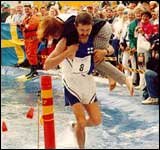
Then I discovered a little known fact: Canada and Finland are known to be world centers of a well established but not widely practiced sport of wife-carrying.

The sport originated as a joke in Finland, supposedly reminiscent of a past in which men courted women by running to their village, picking them up, and carrying them off. The Wife Carrying Contest has very deep roots in Sonkajärvi's local history, despite its humorous aspect. In the late 1800s a brigand ancestor of Pekka's, called Rosvo-Ronkainen, was staying in the area. He allegedly only accepted troops who proved their worth on a challenging track. Village raids were conducted where women were stolen and carried off as if by Rosvo-Ronkainen's bandits.

The competition has been somewhat modified these days. (To begin with, all wives have to be returned.) But the tradition of carrying someone else's wife is still very much alive. Even in the enlightened 21st century it's not necessary to carry your own wife - it can be yours or that of someone you know. The only restriction is that baggage (and we use this word in its technical rather than descriptive sense) must be over the age of 17.

The sport is now practised around the world and has a category in the Guinness Book of Records.

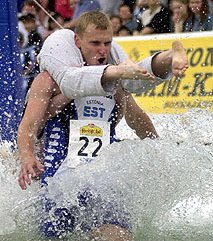
Several types of carry may be practised: piggyback, fireman's carry (over the shoulder), or Estonian-style (the wife hangs upside-down with her legs around the husband's shoulders, holding onto his waist).

Prizes are generous, with the champion receiving the wife's weight in beer, and, intriguingly, "a bag full of wifecarrying products".

The original track in the rough terrain with fences, rocks and brooks has been altered to suit modern conditions. These following rules set by the International Wife Carrying Competition Rules Committee apply:

  • The length of the official track is 253.5 meters, and the surface of the track is partially sand, partially grass and partially gravel
  • The track has two dry obstacles and a water obstacle, about one meter deep
  • The wife to be carried may be your own, the neighbor's or you may have found her farther afield; she must, however, be over 17 years of age
  • The minimum weight of the wife to be carried is 49 kilograms. If it is less than 49 kg, the wife will be burdened with such a heavy rucksack that the total weight to be carried is 49 kg.
  • All the participants must have fun
  • If a contestant drops his wife that couple will be fined 15 seconds per drop
  • The only equipment allowed is a belt worn by the carrier, the carried must wear a helmet.
  • The contestants run the race two at a time, so each heat is a contest in itself
  • Each contestant takes care of his/her safety and, if deemed necessary, insurance
  • Also the most entertaining couple, the best costume and the strongest carrier will be awarded a special prize.
  • Participation fee is 50 euro.
Along with the main event there are also a team competition, a triathlon and a "classic" race. The track is the same but three men in the team carry the wife in turn. At the exchange point the carrier has to drink the official "wife carrying drink" before continuing the race.

This event might seem tailor-made for all those unreconstructed males who still believe the little lady enjoys a bit of macho muscle-flexing.

So, for all of these reasons, I suspect Pekka has qualified as a master in this event, with an international ranking.

If you see him before I do, ask him about it.

And don't believe the first (few) answers he gives you!

Musings from a Failing Mind

First, let's think about immigration (legal or illegal). Our middle class, upper class, and the I-don't-have-to-work class all benefit from the slave labor which provides many of our wants, but we are furious that OUR taxes have to provide for their health and education needs. It hasn't occurred to most of us that if they earned a living wage they might be able to provide for health and education themselves.

Now let's think some more about the wars in Iraq and elsewhere. Have any of you ever heard of the word "propaganda"? There has been a ton of it issuing from the Bush administration ever since 9/11, and it is particularly useful in recruitment and training of the armed forces. Keeping in mind the fact that the propaganda and outright lying began with 9/11, I would divide the groups of members of the current military into the following categories:

Men and women who had chosen military service as a career.

Patriots of any kind and from any level of society who enlisted in the service in their country's time of need.

People who were out of work and facing few alternatives.
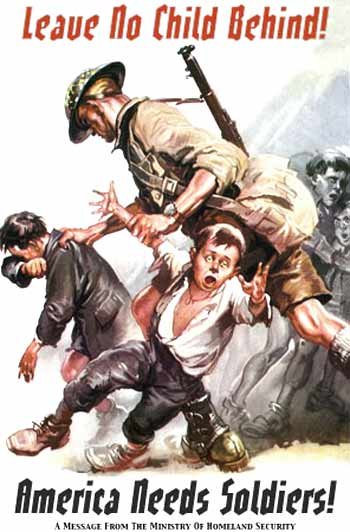
Young people, many uneducated and not yet mature in their view of life.

Macho types who are turned on by the idea of the HUNT.

(Feel free to add, subtract, or criticize the above. We need statistics on these.)

There is a great deal of handwringing about the loss of American lives, but practically none about anyone else. That tells you something about religion and values right there.

At his press conference today, Bush indicated that he hasn't the slightest intention to follow anything proposed by the Iraq Study Group. Instead, he wants to increase our military forces, adding to the permanent standing forces. He mentioned the word "recruitment" but not a whisper of the word "draft". The people who are rich and the people who are enlightened about this war and this leader are unlikely to sign up.

Finally, Bush does not know, although he has used the words "victory" and "peace" that they are not synonymous.

To end on a positive note, hot damn if I didn't hear our Great Leader call again for the American people as a whole to SHOP.